

Get a Free Estimate
Name
Contact Info
Address (autocomplete)
By submitting this form, you are agreeing to the privacy policy.
Validation
Submission
Get Started Today! Call us at 404-798-5296 or
Image
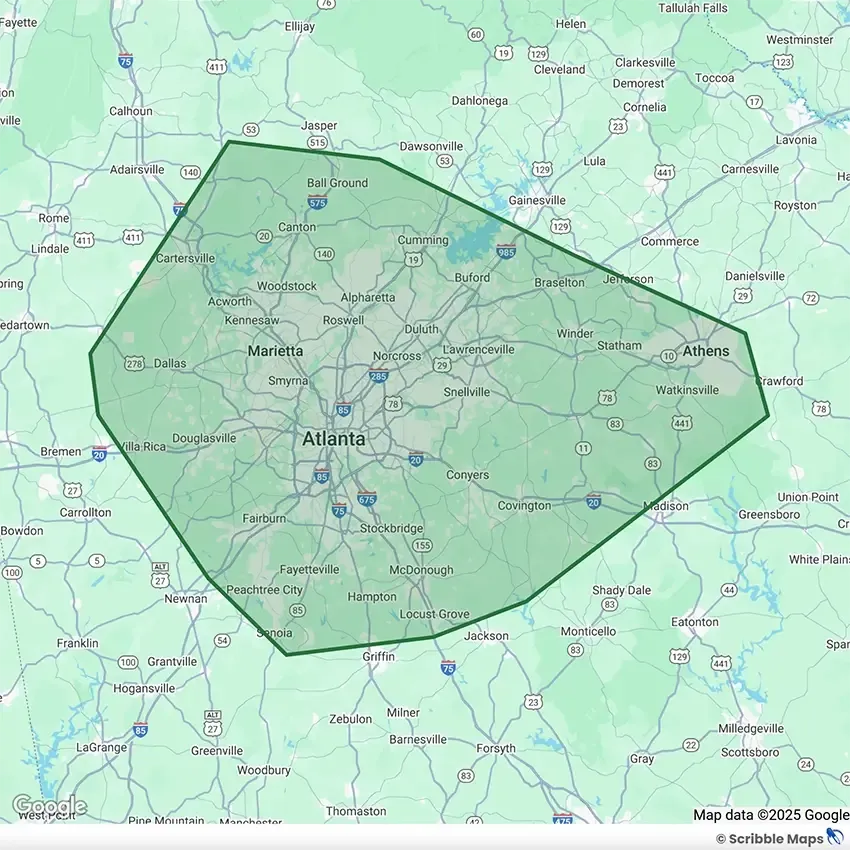
map

Areas We Service in Georgia

1-2 sentences describing the business and service area.

Alpharetta
Athens
Atlanta
Austell
Avondale Estates
Braselton
Covington
Dallas
Decatur
Duluth
Dunwoody
Kennesaw
Lilburn
Loganville
Marietta
McDonough
Monroe
Norcross
Oxford
Peachtree City
Roswell
Sandy Springs
Smyrna
Snellville
Stone Mountain
Sugar Hill
Suwanee
Tucker
Woodstock
Can I mow right after a fertilization treatment?

We recommend waiting at least 24 to 48 hours and watering your lawn before mowing after a fertilization application. This gives the product time to activate and move into the soil where roots can absorb it. Mowing too soon after treatment can reduce effectiveness and stress the turf.

How often should my lawn be fertilized in Georgia?

Our 7-step program runs year-round, January through December, with timing adjusted to your grass type. Warm-season grasses like Bermuda and Zoysia are fertilized from late spring through early fall during active growth. Fescue lawns benefit most from fall and early spring applications when temperatures are moderate and root development is strongest.

When is the best time to start weed control in Georgia?

The most important window for pre-emergent weed control in Georgia is late February to early March, before soil temperatures reach 55 degrees Fahrenheit and summer weeds like crabgrass begin to germinate. A second application in late August to early September blocks winter annual weeds before they emerge. Missing these windows is one of the main reasons weed pressure builds up throughout the season.

What weeds does your program treat?

Our program targets the most common Georgia weeds, including crabgrass, goosegrass, nutsedge, dollarweed, Virginia buttonweed, spurge, and dallisgrass, along with a range of common broadleaf weeds. Treatment selection is matched to your specific grass type, since the right herbicide for Bermuda turf is not always safe for Fescue.

Will fertilization get rid of my weeds?

Fertilization alone won't eliminate existing weeds, but a well-fed, dense lawn is significantly better at crowding out new ones over time. We combine fertilization with timed pre-emergent and post-emergent weed control for best results. The two work together: stronger grass reduces the conditions weeds need to establish, while weed control manages what's already there.

Is the treatment safe for kids and pets?

We follow all product label instructions and recommended re-entry intervals after each application. Most standard fertilization and weed control treatments are safe for people and pets once the treated area has dried. After every visit, we'll communicate any specific precautions so you know when it's safe to return to treated areas.

What affects the cost of a lawn care program?

Pricing is based primarily on the size of your lawn and the treatments included in your program. We bill at the time of each service rather than charging flat monthly fees, and there are no long-term contracts. Properties with significant weed pressure, active disease, or add-on needs like lime or grub control will be priced accordingly. You'll receive a clear estimate during your free inspection before we start anything.

Do you provide lawn care for commercial properties?

Yes. We serve apartment communities, HOAs, commercial campuses, and other commercial properties throughout the Atlanta metro. Commercial lawn care is a core part of our business, and our crews are equipped to handle properties of any size with the same program structure and service standards applied to every account.

Get a Free Estimate
Name
Contact Info
Address (autocomplete)
By submitting this form, you are agreeing to the privacy policy.
Validation
Submission